
Got Gut Health Issues? You may need Bitters! No, not the type you add to alcoholic drinks! DIGESTIVE bitters my friend. Digestive what?? Okay, let’s break it down. Digestive bitters are a blend of herbs that have a naturally bitter taste. In ancient civilizations, consuming bitter herbs was super common, as meals or tonics, from the Egyptians to ancient Greek and Rome to even European folk medicine. But alas, in our modern society, bitter herbs have almost disappeared thanks to fast food, big food companies, and all the packaged convenience foods we have.
What are these bitter herbs exactly?
Great question! The most commonly used bitter herbs are:
- Gentian root – This is one of the most bitter herbs and a key ingredient in many bitters formulas.
- Dandelion root – Dandelion has a pronounced bitter taste and helps stimulate bile flow. P.S. did you know the ENTIRE dandelion plant is EDIBLE?!
- Burdock root – Another very bitter herb that supports liver and gallbladder function.
- Artichoke leaf – Artichoke contains cynarin, which helps increase bile production.
- Wormwood – This herb has a very strong, bitter flavor and can help with digestive issues.
- Chamomile – While not as intensely bitter, chamomile has mild bitter properties and is soothing to the digestive tract.
- Ginger – Ginger is not technically a bitter, but it has carminative properties that help relieve gas and bloating, as well as promotes motility.
Now, what can they do for YOU? Amazing things people, amazing things.
You have bitter receptors throughout your entire digestive tract, including your tongue, the roof of your mouth, and even your esophagus, stomach, small intestine, and colon. Digestive Bitters help stimulate the production of digestive enzymes, stomach acid, and bile flow from the liver and gallbladder. In other words, they get the digestive juices flowing! Kind of a big deal!
I recommend digestive bitters to almost every single patient I work with. Bitters can be particularly helpful for people with conditions like SIBO (bacterial overgrowth), where there may be issues with nutrient absorption, enzyme production, or bile flow. They provide a more comprehensive digestive support compared to just taking enzymes alone. Also, many without a gallbladder can benefit from digestive bitters.
Overall benefits
- Stimulate digestive enzyme production – Bitters trigger the release of digestive enzymes from the pancreas, liver, and stomach, improving nutrient breakdown and absorption.
- Increase stomach acid secretion – The bitter taste stimulates the production of hydrochloric acid in the stomach, which is crucial for proper digestion.
- Enhance bile flow – Bitters help stimulate the release of bile from the gallbladder, improving fat digestion and emulsification.
- Regulate blood sugar and insulin – Bitters can help modulate the release of hormones like insulin, glucagon, and gastrin, which regulate blood sugar levels.
- Improve motility – Bitters can help improve the muscular contractions of the digestive tract, promoting regular bowel movements.
- Reduce bloating and gas – By improving overall digestive function, bitters can help alleviate common issues like bloating, gas, and abdominal discomfort.
- Support liver and gallbladder function – Many bitter herbs have a direct positive impact on the health of the liver and gallbladder.
- Enhance nutrient absorption – Better digestion and bile flow means improved absorption of essential vitamins, minerals, and other nutrients.
- Relieve occasional constipation – The stimulatory effects of bitters can help get things moving in the digestive tract.
- Promote overall gut health – Bitters support the entire digestive system, which is crucial for maintaining a healthy gut microbiome.
Precautions
When it comes to precautions, bitters are generally very well-tolerated. However, they should be used cautiously in a few cases:
- Not for Everyone: People with certain conditions, like ulcers, gastritis, or acid reflux, may find that bitters worsen their symptoms due to the increased gastric acid production. Always consult with a healthcare professional if you have digestive issues.
- Pregnancy and Breastfeeding: Some herbs used in bitters can be contraindicated during pregnancy and breastfeeding. Check with your doctor before using them.
- Allergic Reactions: Although rare, some individuals may be allergic to specific bitter herbs. It’s always best to start with small doses and monitor your body’s response.
- Overuse: Like anything, moderation is key. Excessive use of digestive bitters can overstimulate the digestive system, potentially leading to discomfort, diarrhea, or other issues.
- Drug Interactions: Some herbs used in bitters can interact with medications, particularly those affecting the liver, digestive enzymes, or bile. Always talk to your healthcare provider if you’re on medication.
When to take them?
Bitters herbs should be taken 15-20 minutes before a meal. This allows time for the digestive juices to really start flowing. However, if you forget (like I often do), taking them right before the meal also provides benefit. Place the liquid directly on the tongue and try to hold it there for 10-30 seconds. It may tingle a bit, or feel like it’s burning, but it’s doing the job! If you absolutely cannot stand the flavor, you can get them in capsule form, but they may not have as high of an impact as taking them directly on the tongue.
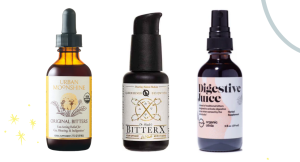
Some of my favorite bitters are:
- Dr. Mercola Organic Digestive Bitters – this one is alcohol free.
- Urban Moonshine – lots of options here!
- Organic Olivia’s Digestive Juice – tastes a bit like black licorice
Overall, bitters are a great natural tool to support healthy digestion. I’d recommend trying a high-quality bitters blend before meals to see if it provides you with benefits.
Work with us to determine if this is something you could add to your daily routine!
- Avau, B., Rotondo, A., Thijs, T., Andrews, C. N., Janssen, P., Tack, J., & Depoortere, I. (2015). Targeting extra-oral bitter taste receptors modulates gastrointestinal motility with effects on satiation. Scientific Reports, 5, 15985. https://doi.org/10.1038/srep15985
- Behrens, M., Gu, M., Fan, S., Huang, C., & Meyerhof, W. (2017). Bitter substances from plants used in traditional Chinese medicine exert biased activation of human bitter taste receptors. Chemical Biology & Drug Design, 91(2), 422–433. https://doi.org/10.1111/cbdd.13089
- Cleveland Clinic. (2022, March 7). The Benefits of Bitters: They’re Not Just for Cocktails. Cleveland Clinic. https://health.clevelandclinic.org/digestive-bitters/
*This blog on the LiveEatPerform Nutrition LLC website is maintained by Lindsey Remmers, Owner. All opinions are her own and for general educational purposes. Advertising, affiliate links or other forms of compensation are within this website and a small commission is earned for sales made through these links (with no extra cost to you) that help cover costs of running a small business. Products and services listed are prior carefully created and/or evaluated to ensure that they are accurate and supported by scientific evidence. Items or programs that are endorsed are based on Lindsey’s professional experience and expertise & are worthy of such endorsement. LiveEatPerform Nutrition LLC assumes no responsibility or liability for damage or injury to persons arising from any use of any product, information, or opinion contained in the information of this blog, none of which is to be considered personal medical advice. By viewing, using, and shopping from this website, you agree to release LiveEatPerform Nutrition LLC from full responsibility to the fullest extent allowed by law. Products & Services sold are not intended to diagnose or cure any disease. Consult your physician before beginning any exercise, supplement, meal plan or program.
Last Updated on December 19, 2025 by Lindsey Remmers

